Diagonal and seam cracking
Diagonals off door corners, split tape joints and the gap along the ceiling line, opened and rebuilt.
(478) 209-3468Call 7 days, 7am–9pm
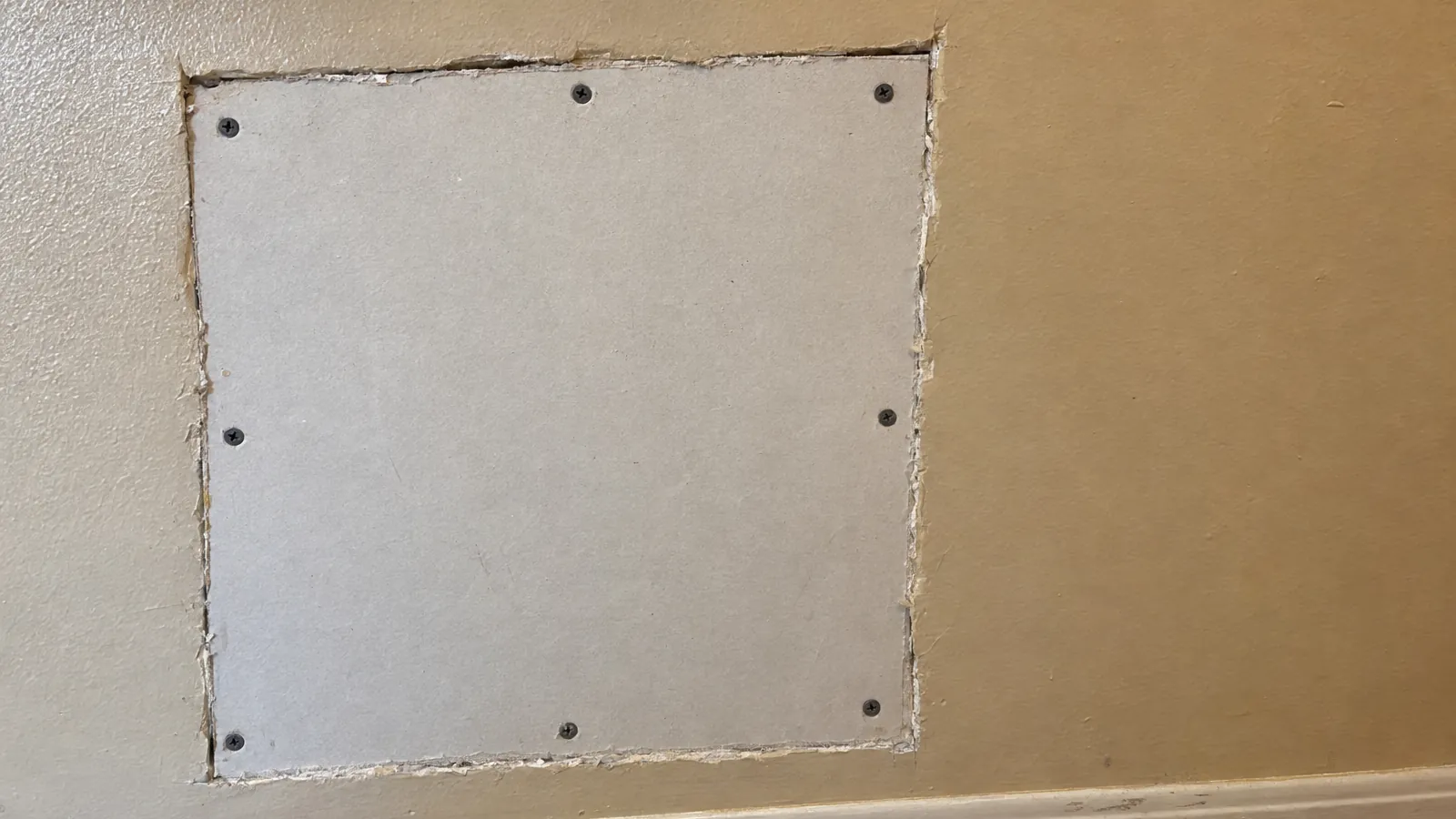
Settling cracks, leak stains, AC drip damage, tired plaster and punched-through holes, rebuilt and given a texture that copies the wall so the repair blends back in.
Call 7 days, 7am–9pm
One call records the damage and queues it for a drywall contractor's quote.
Washington County's seat was incorporated in 1812, and its houses cover a wide spread of building methods. Five-year Census estimates ending in 2024 tally a 2,267-unit housing stock for the city. Of those, 197 were standing by 1939 and 228 went up in the 1940s. About two in three, 1,543 in all, predate 1980.
Age decides the method. A patch suited to a 2005 hallway can let go on a 1940s bedroom wall, because the substrate under the paint is another material entirely.
Rap the wall with a knuckle. Plaster answers with a hard, solid knock, and any hole in it exposes thin wood strips. Its cracks wander and fork, and whole areas can detach from the lath while the paint looks normal. Good practice is to pin loose areas back first, then fill and skim with a bonding compound.
Rooms finished between the 1950s and the 1970s often show taped joints that have shrunk or lifted. Popped fasteners show as little circular blisters spaced along a framing member. Such walls take patches well, though the nearby joints usually want fresh tape too, or the next crack simply follows the old seam.
EPA guidance flags pre-1978 houses as more apt to hold lead-based coatings, and warns that disturbing them can put lead dust into the air. If yours qualifies, ask how dust gets captured and cleaned ahead of the first sanding pass.
Ceilings get noticed last. Water wanders along joists before it surfaces, corner cracks open where nobody looks, and heavy texture disguises a droop until it is plain. NOAA climate normals for 1991–2020 record 48.61 inches of rain in an average year here, with August the wettest month, so a fresh ring overhead after a storm is a familiar sight.
Is a ceiling sagging or leaking right now? Step one: kill electricity to every light or fan on that stretch of ceiling, using its breaker. Step two: empty the room under it and put a pail below the drip. Then phone.
Between them, these five cover the bulk of wall and ceiling trouble in local houses. Each links to a page on causes, methods and national cost figures.
Diagonals off door corners, split tape joints and the gap along the ceiling line, opened and rebuilt.
Rings, soft patches and drooping panels after rain gets past the roof, replaced back to sound joists.
Hallway and closet ceilings marked by an overflowing attic pan, fixed after the gypsum dries.
Bulging or cracked plaster in older rooms, re-anchored with washers and skimmed smooth.
From a pinhole up to something a fist could make, closed with the right backer and finished for paint.
Want them side by side? Browse every drywall and plaster repair we arrange.
Sandersville Drywall Repair Pros is your single contact for the job. We answer the phone or the form, look over the photos, and book a drywall contractor in Washington County to price and complete it. One number covers the whole thing.
Picking up, asking the handful of questions that change the price (which room, how large, still damp or not), sending your pictures and notes ahead so you are not quizzed twice, and putting the work on the calendar for a slot you choose.
A phone conversation about the damage, a figure before anyone touches the wall, then the repair: trimming to solid material, new gypsum or fill, tape and coats, texture reproduced to suit the neighboring surface, and a primer coat ready for your color.
The figure is yours to accept or decline. Say no and that is the end of it, with nothing cut.
More on how the business works is on the about page, and there is a guides section for deciding what a wall needs.
Garage and basement walls break down differently from bedroom walls. Car doors, bicycles and shelf brackets dent them. A concrete slab wicks moisture up into the lowest inch of gypsum. Rain blows in under yard doors. Each of those shapes the fix.
Let it dry out first. If water came in under a door, up through the slab or from a water heater, give the wall time before it is sealed. Gypsum hung over damp studs can stain through, smell musty or grow mold behind the fresh face. A meter reading settles when it is ready.
Some marks can sit for a while; others should not. Drop yours into one of these two columns.
Usually. Orange peel, knockdown, sand finish and smooth walls can all be reproduced; the contractor tests the spray on a scrap or out-of-sight spot before committing. Hand-troweled or very old finishes take more effort and are blended out further so no edge catches light.
No. Tiny jobs are fine to book. If there are other dings or popped screws around the house, list those too; grouping several in one trip normally works out cheaper than separate bookings.
Primer evens out how the patch absorbs paint, so flashing becomes unusual. For the most uniform look, repaint the full wall corner to corner, particularly over older paint that has faded.
Small patches need two or three coats, each left to cure, so they often stretch over two brief trips. Leak-damaged ceilings run longer, since the joists need drying time before fresh gypsum is hung.
Sanded joint compound throws off very fine powder. Ask about plastic sheeting, floor coverings and dust-extracting sanders. Clearing furniture and pictures off the wall beforehand helps a lot.
Rarely. Cracked plaster that is still attached gets pinned and skimmed. Only areas that have dropped or turned to powder normally need cutting out and filling.
The bigger the damaged area, the more coats it takes, the longer it dries, the likelier it needs fresh gypsum, and the wider the texture must reach.
Typical damage: Popped screws, nail holes, anchor tear-outs, a shallow knob dent.
What changes: Filled or bridged with a small backer, two or three thin coats, a light sand, primer. Texture only where the wall already has it.
Fixr's national guide sets drywall hole repair at roughly $60–$200.
Typical damage: Breaks wider than a fist, cracks that follow a tape joint, a dented outside corner.
What changes: Squared off, wood backer fixed inside, fresh gypsum screwed in, tape on all sides, three broad coats, texture carried past the edges.
Fixr also lists drywall crack repair near $60–$330 and ceiling cracks at $100–$500.
Typical damage: A leak-soaked ceiling section, drooping panels, a wall opened for a plumber.
What changes: Wet gypsum removed to dry framing, a drying period, new sheets on the joists or studs, full taping, texture over the whole area, stain-blocking primer.
Fixr's ceiling guide puts water damage at $200–$1,500 and a sagging ceiling at $250–$1,000.
Those figures are national averages from Fixr's 2025 cost guides, not Sandersville prices. Fixr adds that drywall contractors often bill $70–$80 an hour, usually with a one-hour minimum for small jobs. The real figure is the contractor's quote on your wall; it shifts with access, ceiling height, texture and the coat count.
Seven stages, start to primed finish.
Phone, form or photos by text. Say which room, how big, and whether it is damp.
A county drywall contractor calls, hears the details and quotes.
Accept the figure and choose a slot. No cutting or sanding happens before that.
Floors and furniture sheeted. Damaged material trimmed to solid gypsum or plaster.
Backer or new panel fixed, joints taped, base coat of compound applied.
Each coat hardens fully before another goes on. Thick fills may sit overnight.
Texture reproduced to suit the neighboring surface, then primer. Ready for your paint.
Besides Sandersville itself, repairs are booked in these Washington County communities.
To check an address, there is a sentence on each town.
A repair fades from view only when the new material acts like the old one, from the panel up through the finish.
Most walls use 1/2-inch panels, while ceilings and garages may use thicker Type X. Bathrooms often have a moisture-resistant panel. The replacement piece should equal the surrounding thickness, or the joint bulges.
Powder-based setting compound cures chemically and barely shrinks, which suits deep voids and plaster. Ready-mixed bucket compound sands more easily and is kept for the finish passes.
Smooth, orange peel, knockdown and vintage popcorn each call for a different hopper setting and pressure. Test bursts on scrap continue until the spatter looks right, then it is feathered beyond the repair.
Ring with a description, or send over a photo and mention the room. We'll arrange the pricing call and send updates through to the finished wall.
Call about the repairYour call starts it; a county drywall contractor follows up, takes measurements by phone and quotes.